The Strength Nobody Talks About: Knowing What You're Good At
There is a paradox at the heart of most job interviews in 2026. Candidates who have genuinely built impressive careers stumble when asked: "What is your greatest strength?" They hesitate. They offer vague answers like "I'm a hard worker" or "I'm passionate about my field."
Meanwhile, AI tools can write code, analyze data, and generate entire business strategies. The bar for doing tasks has never been lower. But the bar for demonstrating strategic self-awareness, knowing what you uniquely contribute and being able to articulate it, has never been higher.
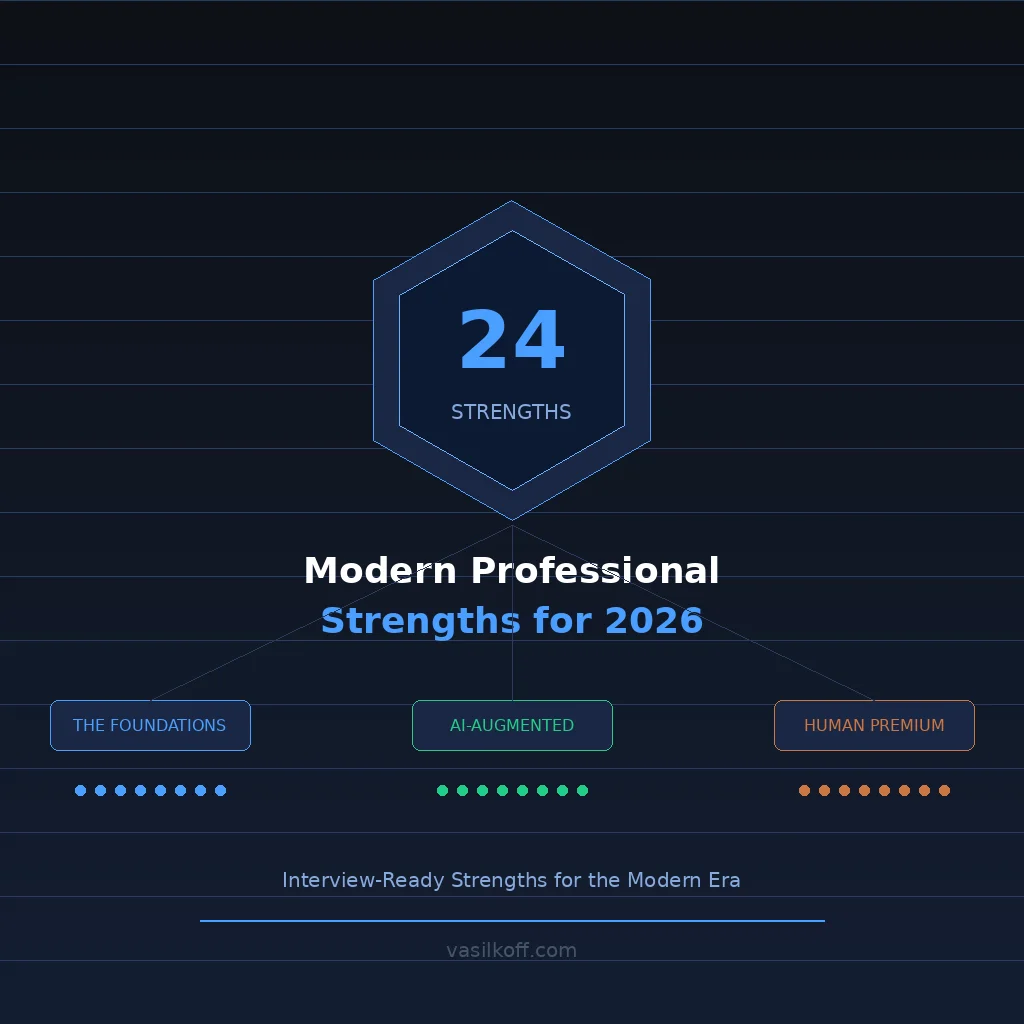
This post gives you 24 modern strengths, categorized for clarity, each with a "The Pitch" sentence that shows you exactly how a professional would say it to a recruiter today.
Category 1: The Foundations (The "Must-Haves")
These are not "soft skills" in the dismissive sense. They are the non-negotiable operating system of every high-performer. In a world where AI handles routine tasks, these foundational competencies determine whether you can direct AI effectively, not just use it.
1. Adaptability
The Pitch: "I thrive in high-change environments by quickly pivoting my workflow to meet shifting project requirements."
Adaptability in 2026 is not about tolerating uncertainty. It is about designing your processes so that pivots are cheap. If you have ever rewritten a product roadmap mid-sprint, switched technology stacks under pressure, or managed a team through a sudden scope change and still shipped, you have this strength. Quantify it.
2. Analytical Thinking
The Pitch: "I excel at breaking down complex data sets to identify the root cause of a problem and provide a data-driven solution."
The ability to structure ambiguous problems into solvable components is what separates senior professionals from junior ones, regardless of their AI tooling. In interviews, show that you can move from "we have a problem" to "here are the three most likely root causes, ranked by impact."
3. Communication Clarity
The Pitch: "I pride myself on translating technical jargon into actionable insights for stakeholders and non-technical teams."
In mixed teams of engineers, product managers, and executives, the professional who can "code-switch" between audiences is invaluable. If you can explain a complex database architecture to a CFO and still have them make a sound investment decision, that is a power move.
4. Attention to Quality
The Pitch: "I maintain a high standard of precision, ensuring that the final output is polished and meets all technical specifications."
This is not perfectionism. It is a systematic commitment to standards. The distinction matters: a perfectionist blocks progress, while someone with true attention to quality builds checklists, review processes, and quality gates that speed up delivery without compromising the result. This is exactly the kind of habit that separates projects that quietly succeed from those that quietly break down over time.
5. Critical Thinking
The Pitch: "I don't just follow instructions; I evaluate the 'why' behind a task to ensure we are taking the most logical path forward."
AI can execute instructions beautifully. A human with critical thinking skills will challenge whether the instruction itself is correct. This is the "human-in-the-loop" superpower. It is the difference between a contractor and a trusted advisor.
6. Decision-Making
The Pitch: "I am comfortable making firm, evidence-based choices even when faced with tight deadlines or incomplete information."
Every senior role involves making high-stakes decisions with imperfect data. Practice naming your decision frameworks. Did you use a pros-and-cons matrix? A reversibility test? A "regret minimization" approach? Having a named process signals maturity.
7. Organization
The Pitch: "I use structured systems to manage multiple competing priorities without compromising on delivery timelines."
Note the word "systems." Organization is not about being tidy; it is about having replicable, documented processes. Tools like Notion, Linear, or even a well-maintained README signal that you have built infrastructure for your own brain.
8. Project Stewardship
The Pitch: "I take full ownership of the project lifecycle, from initial scoping and risk assessment to final deployment."
This is accountability made professional. The opposite of "that was not in my job description." It is the mindset that turns individual contributors into leaders. If you want to see what this looks like at the organizational level, our approach to building products that truly deliver makes this principle the cornerstone of everything.
Category 2: The AI-Augmented Professional (The "Modern Edge")
This is where 2026 diverges from every previous job market. These eight strengths could not have existed five years ago. Professionals who have developed them are operating in a separate league. They are not just "using AI tools": they are architecting workflows around AI capabilities.
9. AI Orchestration
The Pitch: "I treat AI as a force-multiplier, using it to automate repetitive tasks so I can focus on high-level architecture and strategy."
AI Orchestration means you are not a passive consumer of AI output. You are the conductor. You design the chain: which tasks go to which models, in what sequence, with what constraints, and how the outputs are verified. This is a genuinely new professional discipline and it commands a premium.
10. Prompt Engineering
The Pitch: "I am proficient at structured communication with LLMs, which allows me to rapidly prototype ideas and generate technical drafts."
Think of this as a new form of literacy. Being "prompt-literate" in 2026 is equivalent to being "spreadsheet-literate" in 1995. It is no longer optional. Being expert-level at it (knowing about role-priming, chain-of-thought instructions, and output formatting) is a genuine differentiator.
11. Verification & Auditing
The Pitch: "While I leverage AI for speed, my real strength is 'human-in-the-loop' verification to ensure every output is accurate and secure."
This is arguably the most valuable AI-adjacent skill of the decade. Any system can generate content quickly. The professional who can audit that content for accuracy, bias, and security risk is irreplaceable. Understanding how to run local, self-hosted LLM models can give you a practical advantage here, as it lets you experiment and audit without data-privacy concerns.
12. Information Synthesis
The Pitch: "In an era of information overload, I excel at distilling vast amounts of data into concise, high-impact executive summaries."
When AI can produce ten thousand words in seconds, the ability to reduce complexity, not add to it, becomes precious. The professional who hands a CEO a crisp, three-bullet brief that drives a decision is worth their weight in LLM tokens.
13. Workflow Automation
The Pitch: "I look for opportunities to build automated systems that eliminate manual toil, significantly increasing my team's overall velocity."
This is the spirit of engineering applied to every process, not just software. If you have built an n8n or ActivePieces workflow that handles a task that used to take hours, that is your evidence. It is specific, measurable, and impressive.
14. Continuous Reskilling
The Pitch: "I have a proven ability to 'unlearn' outdated methods and rapidly master new tools as the industry evolves."
This is a meta-skill. It is not about what you know right now; it is about demonstrating a learning velocity. Show the stack you have mastered in the last 18 months. Show what you deliberately walked away from. Intellectual agility is the new loyalty.
15. Technical Literacy
The Pitch: "I stay ahead of the curve by maintaining a deep understanding of emerging tech stacks and cloud-native infrastructures."
Non-technical professionals need enough technical depth to evaluate trade-offs, communicate with engineers, and spot when they are being told a half-truth. Technical professionals need to stay current. The bar for "technical literacy" keeps rising; demonstrate that you are raising your floor along with it.
16. Data Privacy & Ethics
The Pitch: "I prioritize ethical considerations and data security in every technical solution I build, especially when dealing with AI."
In the post-GDPR, post-AI-regulation world, this is no longer a "values statement": it is a compliance function. Professionals who understand privacy-by-design, consent frameworks, and AI ethics policies are in high demand. And companies that take data security seriously are the only ones worth working for.
Category 3: The Human Premium (The "Unreplicable Skills")
These are the skills that AI provably cannot replicate: not in 2026, not in 2036. They are the distinctly human contributions that create trust, resolve ambiguity, inspire loyalty, and navigate the messy edges of human relationships. The irony is that as AI handles more routine work, these skills become more valuable, not less.
17. Strategic Leadership
The Pitch: "I lead by empowering my team, aligning their individual strengths with our long-term organizational goals."
Strategic leadership is not about having authority. It is about having alignment. It means you know each team member's operating style (the Belbin framework is a great lens for this), and you architect their interactions to minimize friction and maximize contribution.
18. Emotional Intelligence
The Pitch: "I am highly attuned to team dynamics, which helps me navigate high-pressure situations with composure and empathy."
In a world of remote work, AI intermediaries, and cross-cultural teams, EQ is the connective tissue of every project. The professional with high emotional intelligence can read the room on a video call, de-escalate a client crisis at 6 PM on a Friday, and still make sure everyone on the team feels heard on Monday morning.
19. Conflict Resolution
The Pitch: "I view disagreements as opportunities for growth, and I excel at facilitating constructive dialogue to reach a consensus."
The most expensive conflict is the one that is avoided until it explodes. Professionals who can surface a disagreement early, create a safe space for both sides to be heard, and guide a team toward a decision, without leaving casualties, save companies enormous amounts of time, money, and talent.
20. Interpersonal Networking
The Pitch: "I focus on building long-term, trust-based relationships with clients and partners to ensure sustainable collaboration."
Networking in 2026 is not about LinkedIn connection counts. It is about depth. The professional who has five relationships where the other person would take a call at 8 PM to help solve a problem has more career capital than someone with 5,000 passive followers.
21. Creative Originality
The Pitch: "I bring 'out-of-the-box' thinking to problem-solving, generating unique ideas that go beyond what standard patterns suggest."
AI is trained on existing data. It produces sophisticated combinations of things that have already existed. Human creative originality (the spark that generates a metaphor no one has used before, a product concept that breaks category assumptions, or a design that makes people feel something unexpected) is still exclusively human. Nurture it.
22. User-Centric Empathy
The Pitch: "I always advocate for the end-user, ensuring that our technical solutions solve real human problems, not just technical ones."
The entire history of failed enterprise software is a monument to ignoring this skill. Code that works but that no human wants to use is not a product: it is a liability. User-centric empathy means you have read the fundamental rules of good UI design, you observe real users, and you advocate for their experience when it is inconvenient to do so.
23. Resilience & Grit
The Pitch: "I maintain a steady focus on the finish line, even when projects face unexpected hurdles or market shifts."
Resilience is not about suffering without complaint. It is about having a recovery process. When a project takes a hard hit (a key hire leaves, a market shifts, a dependency breaks) the resilient professional assesses the new reality quickly, adjusts the plan, and re-motivates the team. That is a skill, and it is learnable.
24. Cross-Functional Collaboration
The Pitch: "I bridge the gap between different departments, ensuring that engineering, marketing, and sales are all pulling in the same direction."
The silo is the natural enemy of every fast-moving company. Cross-functional collaboration is the antidote. The professional who can speak engineering's language to a marketing team, translate business constraints back to engineers, and keep both groups aligned on a shared north star is worth more than any single specialist.
How to Use This List
Do not try to claim all 24. Recruiters are smart; a candidate who "excels at everything" excels at nothing.
Instead, use this as a diagnostic:
- Pick your top 5. These are the strengths you can tell a specific, evidence-backed story about.
- Identify your growing 5. These are the ones you are actively developing, especially in the AI-Augmented category.
- Know your honest gaps. A candidate who can say "I am working on conflict resolution: here is what I have tried" is more trustworthy than one who claims mastery of all 24.
The most powerful answer to "What is your greatest strength?" is not a strength at all. It is a story: a specific situation, a specific challenge, a specific action, and a specific result. These 24 pitches give you the opening line. Your experience gives you the rest.
The Bigger Picture
The professionals who will win in 2026 are not the ones who have replaced themselves with AI. They are the ones who have elevated themselves by letting AI absorb the routine and redirecting their human energy toward judgment, relationships, and creativity.
At Vasilkoff, we have been building AI-accelerated teams since before it was fashionable. We know that the best outcomes come from combining AI speed with human accountability. We have written about how this works in practice in our post on empowering AI SaaS development and in our thoughts on what makes outsourcing actually work.
If you are looking for a team that already speaks this language (and can apply it to your next project), we would love to hear from you.
Related Reading
- The Architecture of High-Performance Teams: Belbin Dynamics & Psychological Fortitude: Go deeper on strategic leadership and team design
- 7 Habits That Quietly Break Projects: The professional patterns that erode results over time
- Self-Hosted LLMs: Control, Not Just Privacy: A practical guide to the AI tools that power the AI-Augmented professional
- N8N vs ActivePieces: Automation Comparison: Build the workflow automation muscle with the right tool