
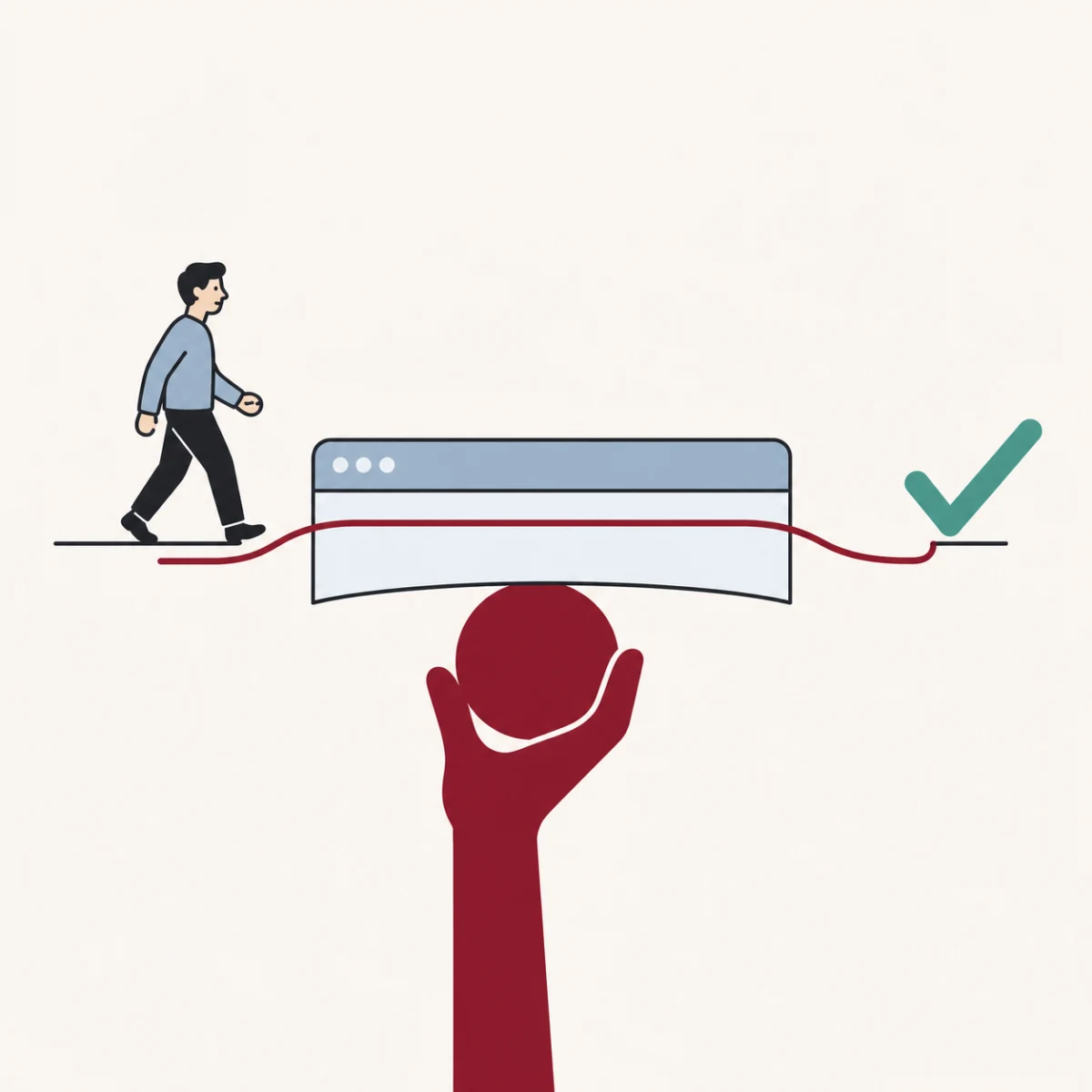
The strongest product claim is not “trust us.” It is “try it.”
Buyers hesitate when the cost of being wrong feels high. They may like the idea, understand the features, and still postpone the decision because they cannot yet answer the question that matters most: Will this work for me?
A free trial, live demo, or sandbox replaces part of that uncertainty with direct experience. The customer can see the interface, test the workflow, and judge the result before making a larger commitment. That does more than generate leads. It changes the sales conversation from promises to evidence.
Why “try before you buy” reduces friction
Every purchase contains several kinds of perceived risk:
- Performance risk: will the product do what it claims?
- Usability risk: will the team actually be able to use it?
- Integration risk: will it work with the buyer's existing process and data?
- Financial risk: will the result justify the cost?
- Vendor risk: will the supplier remain helpful after payment?
Marketing copy can address these concerns, but it remains a claim made by the seller. A working experience gives the buyer evidence they can evaluate themselves.
This is why try-before-you-buy offers are powerful even when the paid engagement is a custom software project rather than a subscription. A prospect may not be able to trial the finished bespoke system, but they can use a relevant tool, explore an interactive prototype, or test a small proof of concept. Each experience makes the supplier less abstract and the proposed outcome more credible.
Free trial, live demo, or sandbox?
These formats solve related problems, but they are not interchangeable.
Free trial: access to the real product
A free trial works best when a new user can reach a useful result without extensive setup. The customer receives access to the product for a limited time, with limited capacity, or both.
The most important design decision is not whether a trial lasts 7, 14, or 30 days. It is whether the trial gives a serious buyer enough time and guidance to reach the first meaningful result. A blank dashboard and a countdown timer are not a trial experience; they are an expiry mechanism.
Good trials include sample content, a short onboarding path, clear limits, and a visible next step. They should demonstrate the paid product honestly rather than hiding the feature that creates its value.
Live demo: a guided path through the value
A demo is better when the product needs context, specialist configuration, or sensitive data. It can be a scheduled walkthrough, a self-guided interactive prototype, or a small working deployment built around one representative scenario.
The goal is not to show every menu. It is to help the buyer recognise their own problem and see the shortest path to the outcome. A focused five-minute demo is often more persuasive than an hour-long feature tour.
For web applications and lightweight backends, platforms such as Render make it practical to host isolated demonstration deployments. A prospect can open a real URL and test the flow without receiving access to production systems.
Sandbox: freedom to experiment safely
A sandbox is the right choice when buyers need to test APIs, workflows, permissions, or integrations. It should behave like the real system while keeping sample activity separate from production data and infrastructure.
Useful sandboxes provide:
- realistic sample data and clear test credentials;
- safe limits on storage, traffic, and expensive operations;
- documentation built around tasks, not just endpoints;
- an obvious reset path when an experiment goes wrong;
- a route to request help or a production-ready demonstration.
The sandbox proves capability without asking for commitment. It also reveals where the real product is confusing, making it valuable for product research as well as sales.
How demos shorten the objection cycle
Without a working experience, sales conversations tend to repeat the same questions: “Can it handle this case?”, “What does the output look like?”, “How difficult is setup?”, and “Will it work on mobile?” Each answer creates another claim for the buyer to verify.
A well-designed demo answers several objections at once. The buyer can complete a task, inspect the output, and form a concrete list of remaining questions. The next conversation becomes specific: not whether the system is plausible, but how it should be adapted, integrated, secured, and supported.
That specificity benefits both sides. Buyers reach decisions with more confidence. Suppliers spend less time giving generic presentations to poorly qualified leads and more time discussing real requirements with people who have already experienced the core value.
What customers can try at Vasilkoff
We use several forms of product-led proof across our own work.
Instant tools
Our browser-based utilities solve a complete task without an account or sales call. You can convert HTML to Markdown, turn Markdown into HTML, clean up rich text as Markdown, or build a Markdown table. These are small products, but that is precisely the point: visitors can judge speed, clarity, and implementation quality directly.
Voice VPN
Voice VPN is a working Vasilkoff product, not a concept presentation. Users can install it and experience the onboarding and connection flow before deciding whether to buy credits. For organisations considering a white-label VPN, the live consumer product is also evidence that the platform has moved beyond mockups and into real-world operation.
Quiz builders and interactive prototypes
For custom applications, a focused demo can reproduce the most important user journey before the full system is commissioned. A quiz builder, for example, can let stakeholders create questions, preview the participant flow, submit a response, and inspect the result. Hosting that prototype in an isolated environment gives decision-makers something concrete to test while keeping the eventual production architecture open for discussion.
Design the offer around confidence, not giveaways
Free access is effective when it helps the right customer make a better decision. It fails when “free” becomes the entire value proposition.
Set limits according to the expensive resource: time, generated output, storage, API calls, or support. Explain those limits before the user encounters them. Protect the environment with rate limits, disposable sample data, and isolation from production. If setup requires human work, qualify the request before building a custom proof of concept.
Avoid asking for a credit card before the user can see any value unless abuse or infrastructure cost makes it necessary. An unexpected automatic charge may create short-term revenue, but it works against the trust that a trial is supposed to establish.
Most importantly, make the transition to the paid offer clear. The customer should understand what remains free, what the paid version adds, what happens to their trial data, and who can help them decide.
Measure whether the trial creates real progress
Trial registrations alone are a weak success metric. A large number of inactive accounts may simply mean the signup form is easy.
Measure the sequence that leads toward value:
- Start: how many qualified visitors begin the trial or demo?
- Activation: how many complete the first meaningful task?
- Depth: how many use the capability most closely connected to purchase intent?
- Assistance: where do users request help or abandon the flow?
- Conversion: how many activated users book a conversation, request a production demo, or become customers?
If signups are healthy but activation is low, adding more traffic will not solve the problem. Improve onboarding, sample data, and the route to the first useful result. If activation is strong but conversion is weak, inspect the limits, pricing, handoff, and clarity of the paid offer.
Let the product carry part of the sales conversation
A free experience does not replace good positioning, documentation, or human support. It makes them more credible. Buyers still need to understand who the product is for and what happens after the demo. They simply arrive at that conversation with evidence instead of assumptions.
Start with the smallest experience that proves the most important claim. That may be a complete free tool, a guided product walkthrough, a temporary deployment, or a sandbox with sample data. Give the buyer one meaningful outcome, then make the next step obvious.
Want to evaluate how we work before committing? Try one of our instant tools, explore Voice VPN, or book a free consultation and request a focused demo. We will help you choose the smallest useful proof for your product idea.