
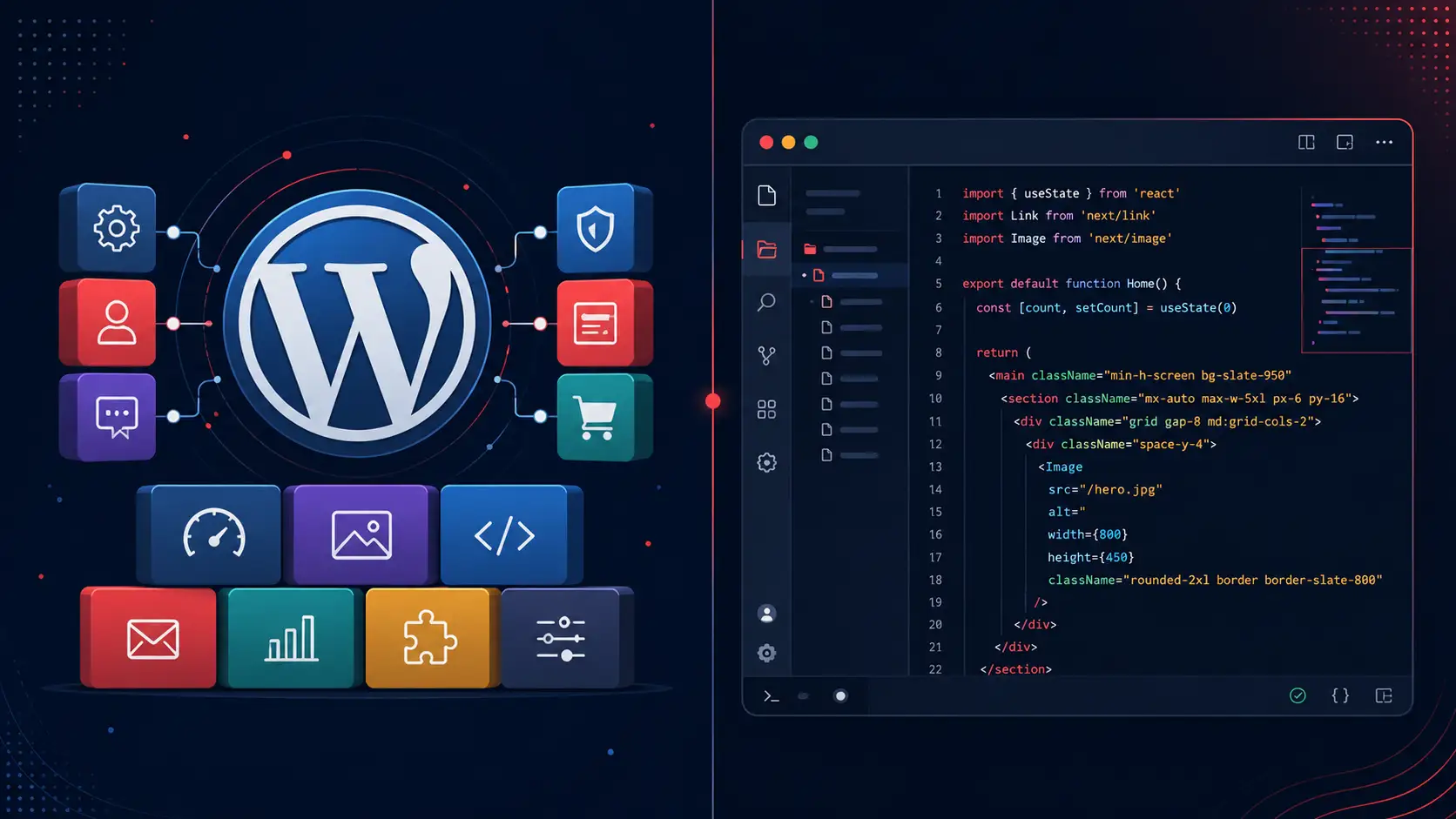
The WordPress vs custom website question comes up in almost every initial client conversation. The honest answer is: for most business websites, WordPress wins. For products with unique business logic, custom development is the right call. Choosing the wrong one wastes money in either direction.
This guide gives you the framework to make the right decision for your specific situation, not a platform sales pitch in either direction. We build both at Vasilkoff, so we have no reason to steer you toward one over the other.
What is the actual difference?
WordPress is an open-source content management system (CMS). You install it on a server, choose or build a theme that controls the design, and add plugins that add functionality: contact forms, SEO tools, e-commerce, booking systems. The content is managed through a browser-based admin interface that non-technical users can handle without developer help.
A custom website is built from scratch. No CMS framework, no pre-made plugins. Developers write code that is specific to your requirements, typically in a framework like React, Next.js, Laravel, or Node.js. Every feature is engineered, not configured.
The practical difference: WordPress gives you a large toolbox of pre-built components. Custom development gives you the ability to build anything, at a correspondingly higher cost and timeline.
When WordPress is the right choice
WordPress is the right platform for your project if:
You need a professional business website. A corporate site for a law firm, accountancy practice, real estate agency, hospitality business, or professional services company. WordPress handles this well and gives your team the ability to update content without calling a developer every time.
You need an e-commerce store. WooCommerce (WordPress's e-commerce layer) is mature, well-supported, and capable of handling most online store requirements, from a 20-product boutique to a catalogue with thousands of SKUs. Shopify is also a strong choice for e-commerce if you prefer a hosted platform.
You need content publishing. Blog, news section, knowledge base, resources library: WordPress is built for this and handles it better than most custom alternatives.
Your team needs to manage content themselves. The WordPress admin interface is familiar, well-documented, and practical for non-technical users. If your marketing team needs to publish pages, update product information, or manage a blog without developer involvement, WordPress is the right choice.
Your budget is under €15,000. Below this level, a custom-built site is rarely feasible. The engineering cost of building what WordPress gives you for free (CMS, user management, media handling, plugin ecosystem) makes custom development economically irrational for standard business website requirements.
When custom development is the right choice
Custom development is warranted when your requirements genuinely exceed what WordPress and its plugin ecosystem can deliver:
You are building a product, not a website. A SaaS platform, a marketplace, a booking engine used by thousands of users simultaneously, a trading platform, a logistics management system. These are software products. WordPress is a content management system, the wrong tool for the job.
Your business logic is unique and complex. If your core workflow cannot be represented by configuring existing plugins, because the logic is specific to your industry or business model, you need custom code. Building workarounds inside WordPress to approximate custom logic is more expensive and more fragile than building it properly.
You need real-time features at scale. Live booking systems with availability checking across multiple resources, real-time data feeds, WebSocket-based interactions, or systems that need to handle thousands of concurrent users: WordPress is not architected for this. A custom Next.js or Node.js backend handles it cleanly.
Performance at scale is critical. For most business websites, WordPress with proper caching performs well. For a platform that handles heavy traffic, complex queries, or data-intensive operations, a custom architecture gives you the control to optimise at every layer.
You need fine-grained control over the user experience. If your product requires interactions, animations, or UX patterns that a WordPress theme cannot deliver, a web app that behaves more like native software than a website, custom frontend development (React, Next.js) is the right path.
The real costs compared
| WordPress | Custom development | |
|---|---|---|
| Standard business website | €3,000–8,000 | €15,000–40,000 |
| E-commerce store | €4,000–12,000 | €20,000–60,000+ |
| Web application / SaaS | Not recommended | €20,000–100,000+ |
| Timeline (typical) | 3–6 weeks | 8–20 weeks |
| Content management | Built-in, easy | Needs to be built |
| Plugin ecosystem | Extensive | None, build everything |
| Ongoing maintenance | Plugin updates, security patches | Code maintenance, dependency updates |
The cost gap is real. Custom development costs more because you are paying for engineering time on everything WordPress provides for free: routing, authentication, media handling, admin interface, SEO tools. Unless your requirements justify that cost, WordPress is the rational choice.
Common mistakes to avoid
Choosing custom development because it sounds more professional. It doesn't make your site more credible to visitors. A well-designed WordPress site and a well-designed custom site look identical to users. Custom development is a technical choice, not a prestige choice.
Choosing WordPress when your requirements genuinely need custom logic. Forcing complex business logic into WordPress through plugin combinations creates fragile systems that break on updates and become unmaintainable. If your requirements are genuinely complex, custom development saves money in the long run.
Buying a WordPress "website" for €500. A €500 WordPress site is a template with your logo added. It shares its design with hundreds of other sites, performs poorly, and cannot be extended without starting over. Budget for a proper custom WordPress theme if the site matters to your business.
Not thinking about who maintains it. Both WordPress and custom sites need ongoing maintenance. WordPress needs plugin and security updates. Custom sites need dependency management and occasional refactoring. Ask who handles this before you sign a contract.
The hybrid option: headless WordPress
For businesses that want the best of both, WordPress's familiar content management with the performance and flexibility of a modern frontend, there is a third option: headless WordPress.
In a headless setup, WordPress runs as a backend CMS only. The frontend is built in Next.js (or another modern framework), calling the WordPress API to retrieve content. The result:
- Content editors use the familiar WordPress admin
- The frontend loads at Next.js speed (significantly faster than standard WordPress)
- The design and UX are fully custom: no theme limitations
- Core Web Vitals scores are excellent
This is what Vasilkoff uses for clients who need editorial flexibility and high performance simultaneously. It costs more than a standard WordPress build (typically €6,000–15,000) but less than a fully custom build, and delivers a stronger technical result.
How to decide
Answer these questions:
1. Are you building a website or a product?
- Website → WordPress
- Product with unique business logic → custom
2. Does your core functionality exist as a WordPress plugin?
- Yes → WordPress
- No → custom
3. Do you need non-technical content management?
- Yes → WordPress (or headless WordPress for performance)
- No → either works
4. What is your budget?
- Under €15,000 → WordPress
- €15,000+ and requirements justify it → custom
5. What is your timeline?
- Under 6 weeks → WordPress
- Longer acceptable → either
If most of your answers point to WordPress, build on WordPress. If your requirements genuinely push you toward custom, build custom, but make sure the scope is locked in a fixed-price contract before you start.
What Vasilkoff builds
We build both, WordPress sites and custom web applications, and we tell clients which is right for their situation rather than defaulting to whichever earns more. If a WordPress build solves your problem, that is what we propose. If your requirements need custom development, we say so and explain why.
All projects operate on fixed-price contracts with a lifetime bug-fix guarantee. We are based in Paphos, Cyprus, and work with clients across Cyprus, the UK, the UAE, and internationally.
Contact us for a free consultation, and we will tell you which approach is right for your project and give you a fixed-price estimate within 48 hours.