
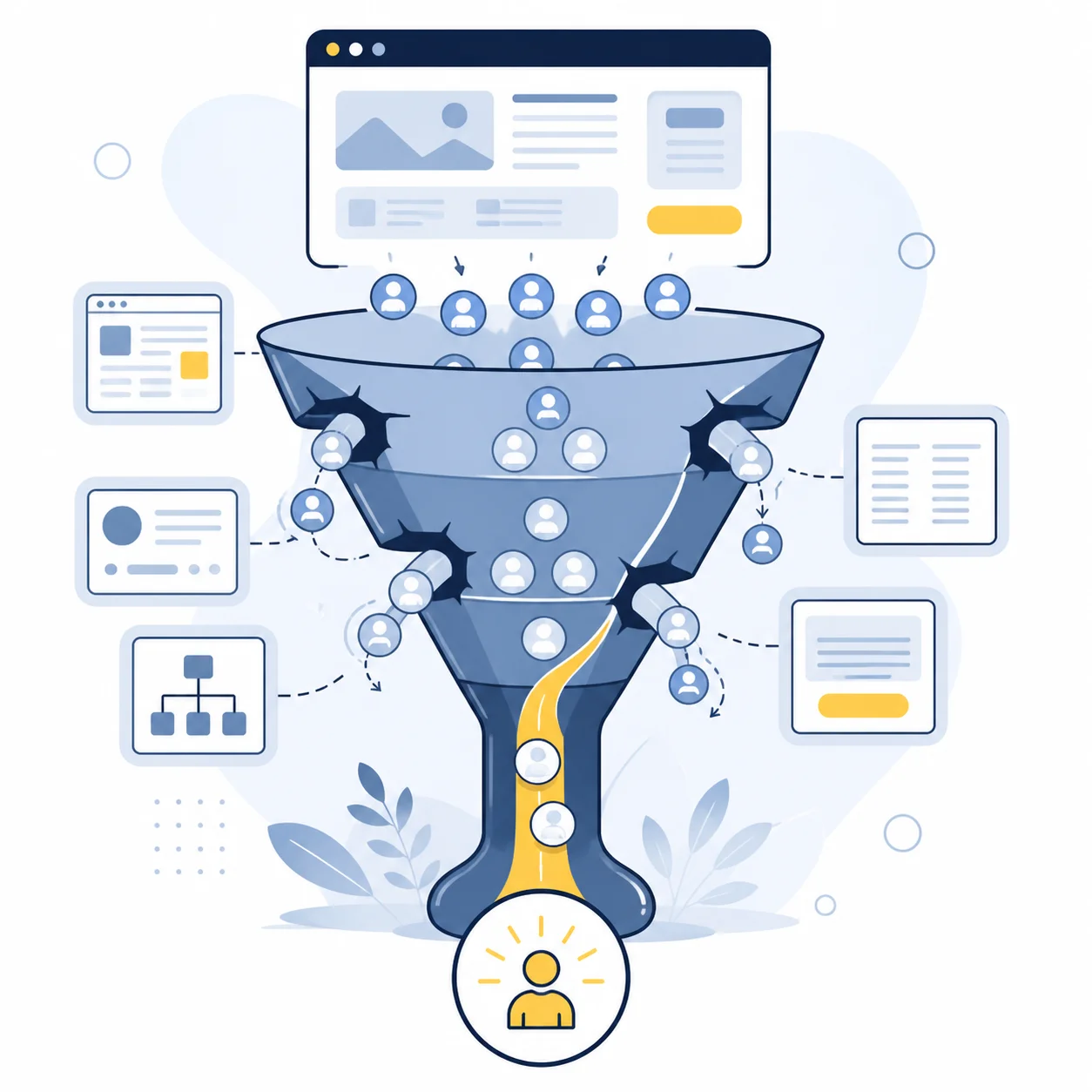
Some websites do not fail loudly.
They look decent. They load. They contain information. The company behind them may even be good at what it does. But the site still underperforms because it quietly leaks attention, trust, and buying intent at every step.
That is what makes website mistakes dangerous. You do not always notice them as "bugs". You notice them as weak conversion, low response quality, and visitors who disappear without leaving an enquiry.
Here are five critical mistakes that push clients away long before the sales conversation begins.
1. A chaotic, unclear first screen
The first screen is the first real contact between the visitor and your business. If it does not answer:
- what this is,
- who it is for,
- why it matters,
then many visitors will not bother going further.
This is where a lot of websites lose momentum immediately. The hero section looks busy or stylish, but the meaning is weak. The visitor sees:
- a vague slogan,
- too many competing elements,
- generic claims,
- no obvious next step.
That creates hesitation. And hesitation kills action.
The first screen does not need to say everything. It just needs to do the most important job: reduce confusion fast.
What a stronger first screen should do
- state the offer clearly,
- show the business value,
- speak to the right audience,
- make the next action obvious.
If your first screen cannot explain "what this is and why it matters to me", the rest of the page often never gets read.
2. Too much text
A website without text does not work. But a website that feels like a wall of text does not work either.
Visitors do not arrive ready to study your page line by line. They scan first. They look for structure, signals, priorities, and proof. If the information is buried in long blocks, people stop trying to decode it.
This is the core problem:
- too much text feels heavy,
- weak structure makes reading harder,
- important details disappear inside noise.
When people must "find the meaning" instead of recognizing it instantly, most will leave.
What to fix
- shorten paragraphs,
- break ideas into sections,
- use stronger headings,
- make key points easy to scan,
- remove repetition and filler.
Good website copy is not about saying more. It is about making the right message easy to absorb.
3. Talking too much about yourself and your product
Many websites sound like self-praise disguised as marketing.
They talk about:
- how experienced the team is,
- how innovative the company is,
- how many services it offers,
- how proud it is of the product.
That may all be true, but it is not where the buyer starts.
Clients do not first look for your autobiography. They look for themselves. They want to understand:
- is this relevant to my problem,
- can I imagine the result for my situation,
- does this team understand what I need,
- why should I trust them with my outcome.
If the site only talks about you, the client never sees their own transformation inside the story.
The shift that improves conversion
Move from:
"Here is how great we are."
to:
"Here is the problem you may be facing, what it is costing you, and how the right solution changes your situation."
You still need proof, expertise, and credibility. But they should support the client's journey, not replace it.
4. Complicated navigation
If the visitor does not understand what to do next, sales friction begins instantly.
Complicated navigation causes problems like:
- users click into the wrong section,
- users miss the main CTA,
- users feel lost,
- users leave before they reach the page that matters.
People rarely say, "This site's information architecture is weak." They just get tired and exit.
That is why navigation should feel obvious, not clever.
The more a visitor has to think:
- where to click,
- where to start,
- where pricing is,
- where contact is,
- how to return,
the more likely they are to abandon the journey.
Good navigation does not show off
It simply helps users move forward with minimal effort.
That means:
- clear menu labels,
- visible calls to action,
- predictable page structure,
- no unnecessary detours,
- no "mystery meat" UX.
If a visitor gets confused, the site is doing work against the sale instead of for it.
5. Weak or unfocused positioning
This is one of the most expensive mistakes because it poisons everything else.
If your website tries to speak to everyone, it usually becomes interesting to no one. The message gets too broad, too soft, and too generic. The visitor cannot tell:
- who this is really for,
- what kind of problem it solves,
- why this option is different,
- why they should choose you over alternatives.
Clear positioning makes decisions easier.
It shows:
- who you serve,
- what you are about,
- what you are not about,
- why your offer is the right fit for a specific kind of buyer.
Without that clarity, the site may still attract attention, but not conviction.
Strong positioning helps the right client say yes
When the offer is specific, the right buyer feels recognized faster. That increases:
- trust,
- message clarity,
- lead quality,
- conversion efficiency.
Positioning is not limitation. It is focus. And focus makes the site commercially sharper.
Why these mistakes matter so much
Each mistake on its own is harmful. Together, they compound.
An unclear first screen lowers curiosity. Too much text kills scanning. Self-focused copy reduces emotional relevance. Complex navigation interrupts movement. Weak positioning removes conviction.
The result is predictable:
- fewer enquiries,
- worse-fit leads,
- lower trust,
- weaker conversions.
Often the business blames traffic quality when the real issue is message and UX friction.
A simple way to audit your own website
Ask these questions:
- Can a first-time visitor understand the offer in five seconds?
- Is the page easy to scan, or does it feel heavy?
- Does the copy focus on client problems and outcomes, not just the company?
- Is the next action obvious on every key page?
- Can the visitor quickly understand who the offer is for and why it is different?
If several answers are "no", the site is likely leaking clients already.
The bigger lesson
Website conversion is not only about design polish.
It is about clarity, relevance, and momentum.
A high-performing website should guide the visitor from:
- understanding,
- to interest,
- to trust,
- to action.
When that path is broken, even a visually good site can underperform badly.
Related Reading
If you are fixing website conversion problems, these articles connect directly to the same issue:
- Conversion-Focused Web Development: The Complete Guide: the full picture on briefing, building, and measuring a website for commercial outcomes.
- Website Copy That Converts: what to say and what to cut to turn visitors into enquiries.
- CRO for Service Businesses: the five-point diagnosis and the three highest-ROI fixes.
- A Website Without a System Is Just Decoration - why the site only becomes a sales tool when chat, CRM, and follow-up workflow exist after the first enquiry.
- G4 Analytics 101: Track What Matters, Not Just Traffic - how to measure real funnel steps instead of guessing why users drop off.
Want a website that converts more clearly?
If your website looks fine but underperforms, the problem is often not traffic first. It is clarity first. Explore Get AI Chat, review our portfolio, or contact us if you want help turning a confusing website into a clearer sales tool.