
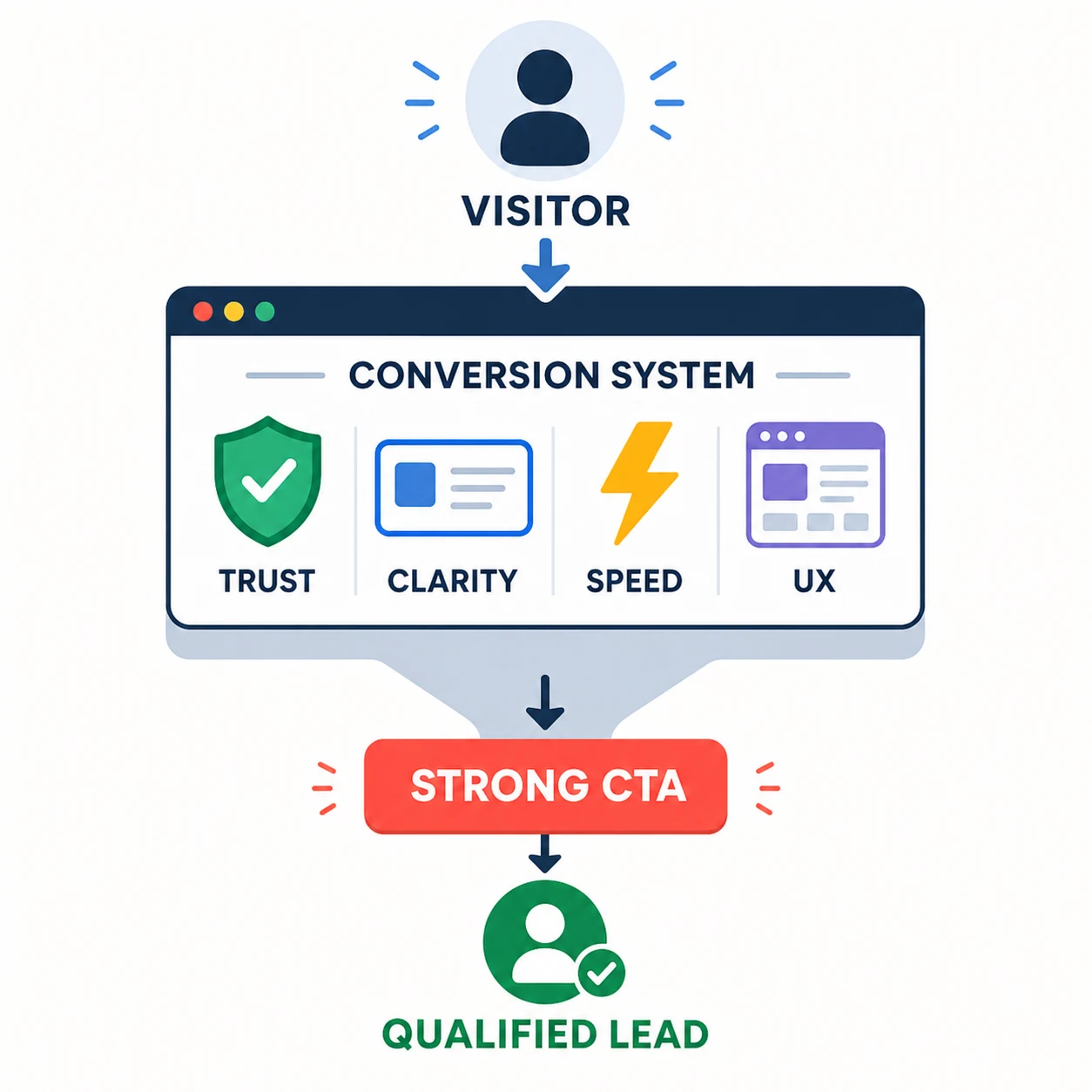
You can have good traffic and almost no enquiries. That gap is a conversion problem, not a traffic problem.
Many service businesses (law firms, agencies, consultancies, development studios) invest in SEO and ads to drive visitors to their website, then wonder why the phone stays quiet. The diagnosis is almost always the same: the site was built to look credible, not to convert.
Conversion Rate Optimisation (CRO) is the discipline of closing that gap. It is not about redesigning your website every year. It is about systematically identifying where visitors drop off and fixing the specific friction that causes it.
What a "good" conversion rate looks like for a service business
A service business website that generates enquiries from cold traffic typically converts between 1% and 5% of visitors into a contact form submission, call booking, or direct message, depending on traffic quality and average deal size.
If your site is converting below 1% on relevant traffic, you have a CRO problem. If it is converting above 3% consistently, you are doing most things right. The benchmarks vary by sector, but the diagnostic process is the same regardless.
The five-point CRO diagnosis
Before changing anything on your site, answer these five questions. Each one points to a different category of fix.
1. Do visitors understand what you do in under five seconds?
Open your homepage on mobile. Without scrolling, can a stranger read one sentence and understand: (a) what you do, (b) who you do it for, and (c) what makes you worth contacting?
If the answer is no, or if the hero section is a full-bleed photograph with no text, you have a clarity problem. No amount of CTA optimisation fixes a headline that does not communicate the offer.
2. Is there a reason to act now rather than "later"?
Most service websites give visitors no reason to contact you today rather than next week. "Later" almost always becomes never.
Urgency does not require a countdown timer or fake scarcity. A free consultation with a clear scope ("30-minute call, no pitch, leave with a clear brief") removes the psychological cost of clicking. A specific result-oriented offer ("we audit your current site in 48 hours") creates a reason to act today.
3. Is the contact friction low enough?
Every additional field in a contact form costs you conversions. Every vague CTA ("Submit" / "Send") costs you conversions. Every form that requires a phone number costs you conversions.
Minimum viable contact form for a service business:
- Name
- One open text field ("Tell us about your project")
- Submit button that says something specific: "Get a free consultation" or "Start my project"
Phone number, budget range, company size, and project timeline (if you need them), collect them in the follow-up call. Not on the form.
4. Is there enough proof before the ask?
Visitors will not contact you based on your own claims. They need third-party evidence: a named client, a case study result, a testimonial with a real name and company, or an award.
If your homepage leads with services and ends with a contact form, with nothing verifiable in between, your conversion rate will reflect the absence of proof, regardless of how well designed the page is.
Proof does not need to be elaborate. A single sentence: "Vikentilia.eu: full real estate platform with dynamic search and listing management, launched for a Cyprus property agency in 2024" does more work than three paragraphs of generic claims.
5. Is your site fast and functional on mobile?
Over half of service business enquiries now come from mobile. A site that takes more than three seconds to load on a 4G connection, or that has a contact form that is hard to fill on a phone, is actively losing conversions that would otherwise close.
This is a technical issue, not a design issue. Core Web Vitals are measurable: if your site scores poorly on mobile performance, fix that before any copy or design change. [needs source: Google CWV benchmarks]
The three highest-ROI CRO fixes
If you can only make three changes to a service business website to improve conversions, these are the ones with the most consistent impact:
1. Add a sticky CTA on mobile A floating "Get a free consultation" button that stays visible as users scroll on mobile can lift mobile conversions significantly without changing any other content. Implementation time: under an hour for most web platforms.
2. Move your strongest proof above the fold If your best case study or testimonial is at the bottom of the page, move it up, directly under or alongside your headline. Proof seen before the first CTA converts better than proof seen after it.
3. Replace vague CTAs with specific ones Audit every button on your site. Replace "Contact us" with "Get a free consultation." Replace "Learn more" with "See how we built [X]." Replace "Submit" with "Start my project." Each change takes minutes and compounds across all traffic.
What CRO is not
CRO is not:
- Redesigning your website because the current one "doesn't feel modern"
- Adding more content to pages that already have too much
- A/B testing button colours before fixing your headline
- Hiring a new photographer before fixing your form
A website that looks great and converts poorly is a more expensive problem than a website that looks average and converts well. Design without conversion intent is decoration: it signals competence to the visitor but does not move them toward action.
The goal of a business website is not to impress. It is to convert the right visitors into enquiries, consistently and measurably. Everything else is secondary.
Making CRO a continuous process
One round of fixes is a start, not a system. The businesses whose websites consistently outperform their competition treat CRO as an ongoing process: measure, diagnose, fix one thing, measure again.
The minimum viable CRO stack for a service business:
- Analytics: Google Analytics 4, properly configured with conversion events (form submissions, not just pageviews)
- Heatmaps: Hotjar or Microsoft Clarity (free) to see where visitors click and where they stop scrolling
- Regular form audits: check form completion rates monthly; a sudden drop usually signals a broken field or a UX regression after an update
You do not need a specialist agency to run this. You need a developer who understands that a website is a sales tool, not a brochure, and treats it accordingly.
See also: Website Copy That Converts and Webpage Optimisation Checklist.