
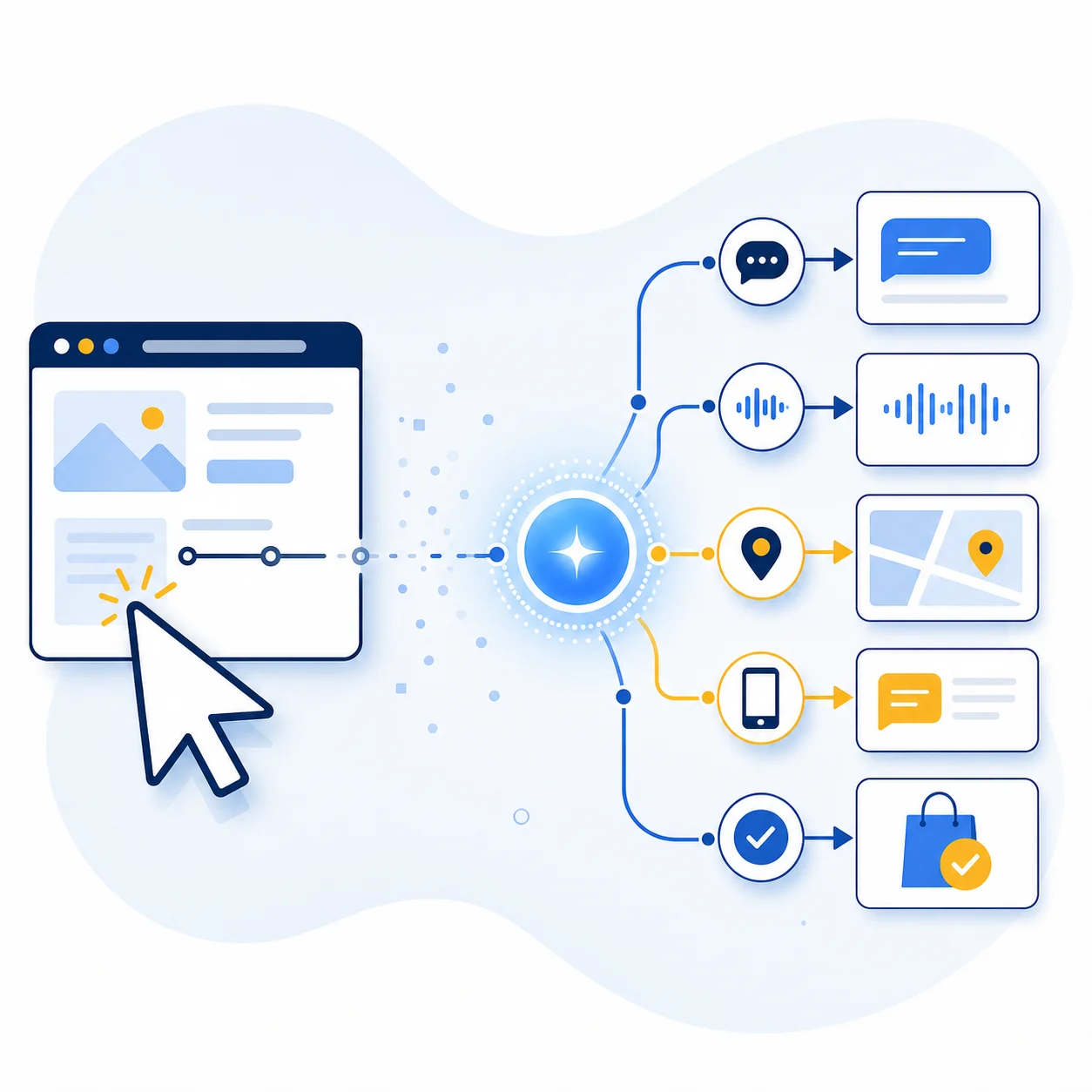
The click was never the goal. It was only the route.
For decades, digital marketing followed a familiar sequence:
Search -> click -> website -> action
Businesses built pages, ranked them, bought traffic, and measured success by how many people arrived. The website sat in the middle of almost every journey.
That sequence is now being compressed.
A customer can ask an AI assistant for a recommendation, compare providers in a marketplace, check a business in Maps, read reviews, and start a conversation in WhatsApp without visiting the company's homepage. The decision still happens online, but the website no longer owns every step.
The click is not literally disappearing. It is losing its monopoly.
From a list of links to a finished answer
Traditional search gave people options. It returned a page of links and left the research to the user.
Answer engines do more of the work. They summarise, compare, filter, and recommend. A person may only click when they need evidence, want to complete a transaction, or do not trust the answer they received.
The same pattern already exists outside AI search:
- Maps can show opening hours, reviews, directions, photos, and a call button.
- Marketplaces can compare price, availability, and reputation without exposing the seller's site.
- Social platforms can move a user from discovery to direct message inside one app.
- Voice assistants can provide a single spoken response instead of ten blue links.
- AI assistants can turn information from multiple sources into one recommendation.
In each case, the user gets closer to an outcome with fewer page views.
That is good for the user. It is uncomfortable for businesses that treated traffic as the product.
Your website still matters, but its job is changing
Saying "the click is dead" does not mean the website is dead.
Your site is becoming less important as a required destination and more important as infrastructure. It gives search engines, AI systems, prospects, and partners a reliable account of:
- what you do,
- who you serve,
- where you operate,
- what makes your offer different,
- what your work has achieved,
- how to contact or buy from you.
Even when a prospect does not visit, information from your site may influence the answer they receive elsewhere.
When they do visit, they are often further along. They may not need a long introduction. They need proof: a relevant case study, a clear price or process, credible reviews, and an obvious next step.
The website therefore has two audiences:
- People validating a decision.
- Systems deciding whether to include you in an answer.
A vague brochure serves neither audience well.
The real threat is exclusion
In the old model, the primary marketing question was:
How do we rank high enough to earn the click?
In an answer-first model, the more important question is:
Will we be considered at all?
An AI assistant cannot recommend a business confidently if its offer is ambiguous, its claims are unsupported, or its information conflicts across the web. A local platform cannot present the correct opening hours if the business never updates them. A marketplace cannot compare an offer that has no clear scope.
Visibility now depends on being understandable and verifiable.
That means publishing:
- specific services instead of broad slogans,
- clear locations and service areas,
- consistent company and contact details,
- case studies with real constraints and outcomes,
- named expertise and credentials,
- useful answers to the questions customers actually ask,
- current pricing, availability, or process information where practical.
This is not a trick for manipulating AI. It is basic business clarity, expressed in a form that both people and machines can use.
SEO is becoming a supply chain
SEO is not dead. But "rank a page and collect a click" is no longer a complete strategy.
Search optimisation now supports a wider discovery system. Your content may supply a search result, an AI answer, a map listing, a product comparison, or a recommendation long before it produces a session in analytics.
Technical fundamentals still matter:
- pages must be crawlable,
- important information must exist as text rather than only inside images,
- headings and page structure must be clear,
- structured data should describe the business accurately,
- duplicated or outdated claims should be removed,
- important pages should load quickly and work on mobile.
But technical SEO cannot rescue an indistinct business.
If five agencies all claim to deliver "innovative digital solutions", an answer engine has little reason to choose one. If one agency shows exactly whom it serves, the systems it builds, the evidence behind its claims, and the regions it covers, it is easier to understand and easier to recommend.
The durable advantage is not keyword density. It is being the clearest credible answer to a specific need.
Stop treating traffic as the whole score
Traffic remains useful, but it is becoming a less complete measure of demand.
Imagine that a prospect discovers your company in an AI answer, checks your reviews in Maps, and calls the number shown there. The journey created value, but your website analytics may record nothing.
Businesses need to measure outcomes across channels:
- qualified enquiries,
- calls and messages,
- branded searches,
- referral and review activity,
- mentions in relevant platforms,
- lead source captured in CRM,
- conversion rate by channel,
- customer acquisition cost,
- repeat business and referrals.
Ask new leads how they found you. Use distinct links or contact routes where appropriate. Keep source data in CRM instead of relying entirely on browser analytics.
The measurement question is no longer just "How many people visited?" It is "Where did confidence form, and what caused the customer to act?"
What to change now
1. Define the answer you want to own
Choose the problem, customer, and market for which your business should be an obvious recommendation.
"Web development" is too broad. "Conversion-focused websites for professional service firms in Cyprus" is specific enough to establish relevance.
2. Make your facts easy to extract
State services, locations, process, guarantees, contact details, and differentiators directly. Do not hide essential information behind clever headlines, animations, or downloadable PDFs.
3. Publish evidence, not adjectives
Replace claims such as "high quality" and "industry-leading" with case studies, examples, testimonials, certifications, and measurable outcomes.
Systems can repeat a claim. Evidence gives them a reason to trust it.
4. Strengthen the sources around your website
Keep business profiles, directories, marketplaces, review platforms, and social accounts accurate. Consistency across independent sources makes your company easier to verify.
Your website is the source of truth, but it should not be the only place where that truth appears.
5. Build direct channels
Give people a reason to subscribe, follow, message, or return. Email lists, communities, customer portals, and useful follow-up create relationships that an algorithm cannot take away with a ranking change.
6. Shorten the route to action
Let customers call, book, message, request an estimate, or buy through the channel they are already using. Do not force a website visit merely to satisfy an old funnel.
7. Keep the website ready for validation
When a prospect does click, assume they are checking whether the recommendation is credible. Show the strongest proof quickly. Make the offer understandable. Remove friction from the next step.
Build a business worth recommending
The old internet rewarded businesses that were good at attracting visits. The emerging internet rewards businesses that are easy to understand, verify, and recommend.
That changes the role of digital marketing:
- content becomes evidence,
- SEO becomes discoverability across systems,
- the website becomes a source of truth and a place to validate,
- direct channels become strategic assets,
- business outcomes matter more than session counts.
The click will remain useful. People will still browse, compare, investigate, and buy on websites. But it will no longer be present in every journey, and strategies built around that assumption will misread the market.
Do not optimise only for the visit.
Optimise to be included in the answer, trusted in the comparison, and chosen when the customer is ready to act.
See also: Your Website Is Leaking Clients: 5 Mistakes That Kill Sales, Website Copy That Converts, and A Website Without a System Is Just Decoration.